This entry covers the time we spent in central Australia before and after our tour. I've slipped out of tourist advice mode lately but here's 3 things I wish someone had told me:
1) Don't plan to spend much time in Alice Springs - you can fly into and/of out of Uluru. And either way, Qantas is the main operator (Tiger also flies to AS 3 days a week) so flights can get pretty expensive if you leave them to the last minute.
2) Tours are cheaper if booked in AS (rather than before you fly) where there is plenty of competition, and I suspect that virtually no notice is needed, at least outside the peak season.
3) Buy a fly net to keep the flies off your face! $5 or less in AS, I wish I'd bought one, at least for the Uluru base walk...
And something that nobody told me but fortunately we didn't miss:
4) Don't come all the way out here without going to Kings Canyon, because it beats Uluru hands down.
As soon as you get off the plane - and we got off the plane early in the morning as it's 1.5 hours behind Melbourne here - it is obviously very hot, and there are clearly a lot of insects. There are plenty of big beetles and grasshoppers that have been crushed by luggage trolleys inside the airport.
Unfortunately 'The Alice' is a fairly charmless place with not much going on, and a lot of locals sitting around on the kerb for want of anything better to do. Most of the town is reasonably modern but soulless and more spread out than you would like in a place this relentlessly hot. It presumably sees a lot of tourists passing through (you can fly direct to Uluru but tours commonly leave from here) but not many sticking around, and the ones who are here either have just got or are about to get up early for a tour.
On the positive side, the view from the top of Anzac Hill is worthwhile - a decent view of the scenic McDonnell Ranges that surround most of the town. Sadly we couldn't find anything else worthwhile to do in town. There are a couple of buildings of 'historical significance' - but, for example, the gaol is open only mornings, then only half the year, and is so tiny I find it hard to believe it would have been of much interest. So the part-day we spent in The Alice before our tour was quite enough. Unfortunately we'd already planned to spend a full day here afterwards too.
After our outback tour, we dragged our seriously aching limbs to Alice Springs Desert Park. This aims to show in one relatively small area all the different types of central Australian landscape.* It's reasonably successful, if a bit low-key - if you have a keen interest in the outdoors you'll have a field day (pun, as always, intended). They have some good reptile and bird houses, a less than successful nocturnal animals habitat (they use lighting to reverse daylight hours and get nocturnal creatures out during visiting hours, but it's too dark to see most of them), a good birds of prey show and a decent film show - with a nice touch at the end, where they segue from "Enjoy the natural landscape" by lowering the projection screen to show a big glass window with a great vista of the beautiful McDonnell Ranges which frame the park. Worth visiting if you're in town - not really worth being in town for though.
* Flying from AS to Sydney (for a connection to Brisbane) I got a window seat and the way the landscape changes quite abruptly is amazing. At times I felt like I was looking down on a different planet. Yes, mostly Mars. But there were also 'regular' (yellow sand) deserts and salt flats and forests. An enjoyable flight for that reason.
We finished up here with dinner and drinks in Bojangles - a fun bar full of Australiana which is also the base for the local radio station. They also like to have fun with the bathrooms - the toilet seats are clear plastic filled with barbed wire or razor blades, and the taps control random sinks rather than adjacent ones - ditto the controls of the hand dryers. Oh, those wacky locals. You can also head to their website to watch the bar on one of several cameras, and even buy your mate their a drink from the comfort of your own home. Sadly nobody seemed to be watching while we were there...
And now we're off! Hopefully Queensland will be at least slightly cooler with slightly fewer flies... Please don't disillusion me if you know otherwise.
Showing posts with label Red Centre. Show all posts
Wednesday, 24 March 2010
Sunday, 21 March 2010
Ayer-raising sights
On Friday morning our little tour bus drives out through the gap in the McConnell Range south of Alice Springs as the morning sun is starting to hit the red rock all around - here, it's interspersed with little patches of green.
The land in general is greener than I expected - this is semi-arid desert, so there are still trees and bushes and grass, though the soil is red. There's not a lot of water, even though there has been an unusual amount of rain recently - the rivers are puddles, but not dry. And it's pretty hot - 32° in the shade, 34°-37° in the sun today. We're coming towards the end of the off season here. Peak season is April-September.
The three main things we're here to see are Uluru (better known as Ayers Rock), Kata Tjuta (aka the Olgas), and Kings Canyon. We're on a tour with (at various stages) 6-10 other people - all female. Normally where you have a decent tourist attraction, tour operators will look for a few other things 10-20 miles away that they can throw in to make up a bigger tour. Here, they throw in pretty much everything within a few hundred kilometres, because those three are pretty much all there is to see for hundreds of kilometres in each direction. But they are very fine sights - and I get plenty of time to catch up with my reading on the bus.
It's a bit of a drive from Alice Springs to Uluru: "462km, 2 right turns, no left turns" as our driver puts it. Along the way there are a couple of rest stops. First up is the camel farm. You can ride a camel once round the yard for 6 bucks - the same price as a camel burger.
They also have emus, kangaroos and a dingo. Further down the road, at the last beer shop before the rock, there's a fine display of colourful parrots, a cockatoo that startles Lilly by saying "Hello" (I know, I was expecting it to say "G'day", too), more emus wandering around and more kangaroos. They have a "Help wanted" sign up here, if anyone fancies a job with a bit of a commute. It's also fun to see supply and demand in operation as the prices of everything rises along the road.
Kata Tjuta is our first activity. It's only about 30km from Uluru as the crow flies, but completely overshadowed (metaphorically - Uluru isn't that tall), which is a shame because it's a stunning place.
From above ground it appears to consist of 36 huge rounded rocks which rise as high as several hundred metres above ground and descend up to 5km into the earth below. Some of the rocks run together, making it a mass of red stone hills and valleys. It looks a bit like Uluru might if it were selectively eroded - the rock is different but looks very similar from any real distance. Its Aboriginal name means "many heads".
We go on the Valley of the Winds walk, which leads up and down and through, with some great views and occasional glimpses of rock wallabies in the distance. We don't get to do the whole circuit because 4 days earlier a huge amount of water fell, leading to big black marks where water ran down the rocks and several washed-out paths. But we see enough to be very impressed.
We drive to a lookout near Uluru for sunset - not that spectacular since the spot is both very busy and in between Uluru and the setting sun. There's a great little lookout point by our campsite where you can see Kata Tjuta against the sunset, and I sprint up there when we get back for a just-in-time photo.
Of course the great night-time view is upwards. With no moon, virtually no lights and no clouds, the night sky is unbelievable. I have never seen so many stars, not even close, even in the countryside, or in the Canadian Rockies. Just breath-taking.
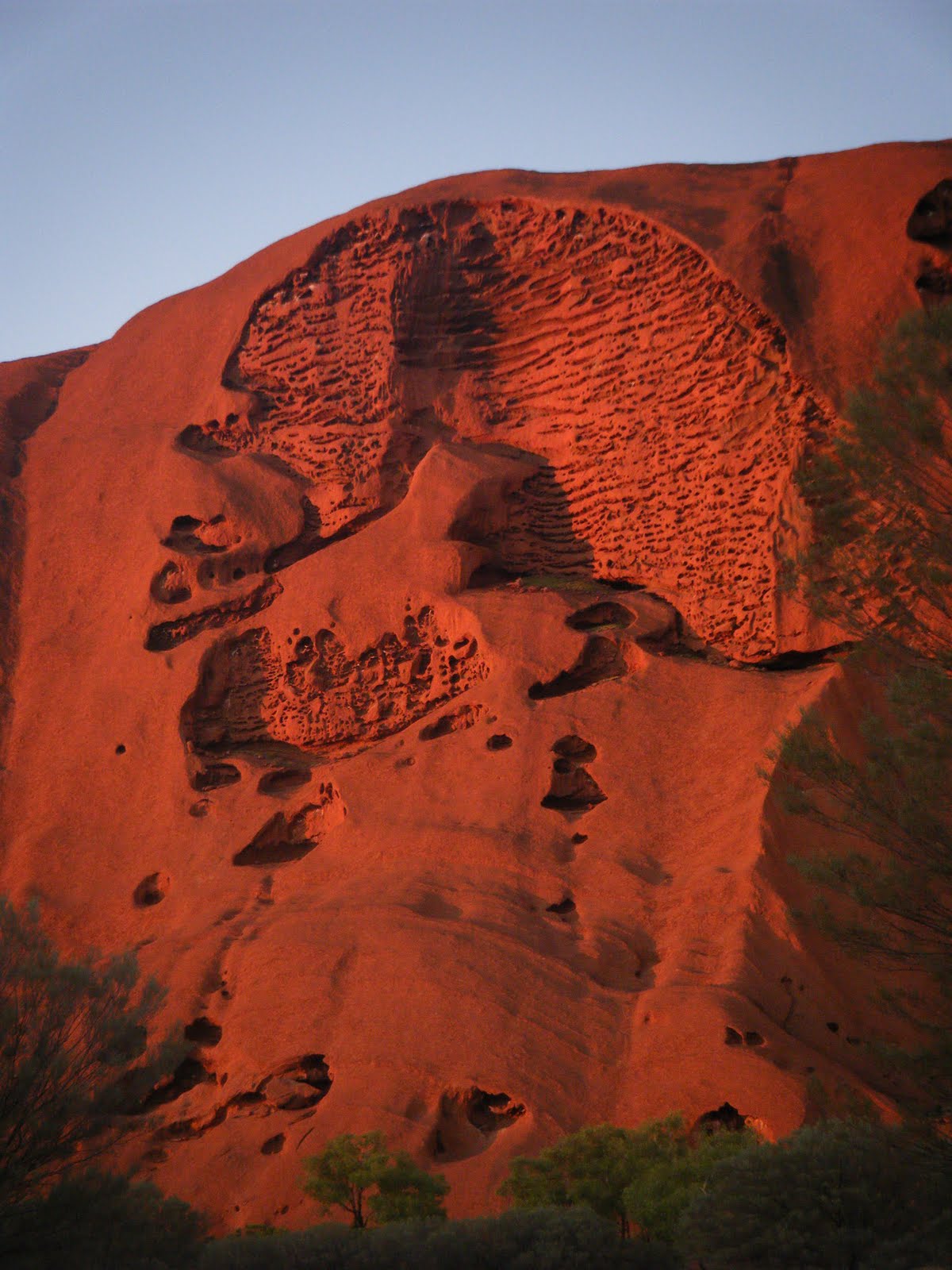
Also breath-taking was how early we have to get up to be at Uluru for sunrise. It's a bit better than sunset, and the great advantage is that you can walk the 'base walk' loop around the rock without the crowds or heat that come a little later. At times, Lilly and I are the only people around - which means there are approximately 1,000 flies for each of us. Every time I stop walking to take a photo they swarm and I invariably end up with one in my ear while snapping away. This is a pretty good walk - long but not unbearably so (though the shade is very welcome as early as 7:30 a.m.), starting some way from the rock to give you perspective but getting closer until you can touch it, or play frisbee by it, for the second half of the walk.
One of the reasons to see Uluru at sunrise and sunset is that it famously changes colour. For my money this is very overplayed. Hardly a surprise that it looks different in the dark from indirect sunlight from direct sunlight!
Climbing Uluru is a bit controversial. It is permitted, but the Aboriginal people prefer you not to - so there is a sign saying "Please don't climb", but the entrance gate is only closed in adverse weather (which includes being too hot). The info centre says that the proportion of visitors who climb has fallen from c75% to 37%, and cryptically adds that some nationalities are more likely to climb than others. (We noticed that some nationalities are also more likely to give the peace sign or try to take a photo in mid-jump on the Rock. But this is presumably a tour operator thing - if your bus stops and the guide says "Today we are climbing that great big rock", you generally climb the rock.) The main reason given for not climbing is that the Aboriginals feel responsibility for visitors and are sad if they are hurt or die while climbing. There's clearly more to it than this (I believe that Aborigonals only climb as a rite of passage), but neither the rock nor the cultural information centre makes any attempt to explain it. In fact the centre as a whole tells you very little about Aboriginal culture apart from what they eat, and in general they disclose very little of what they do at Uluru and nothing of what they do/did at Kata Tjuta. They are perfectly entitled to their privacy; but if they want people to respect their beliefs, they might gain more traction if they explain them.
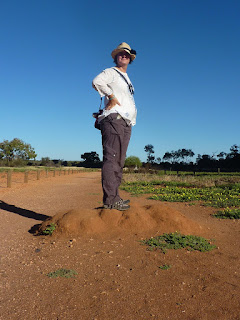
We hadn't planned to climb, and I wouldn't have done if it looked like nobody else was. But there were three coachloads of Japanese tourists up there at the time, so the amount of extra offence we were likely to cause seemed minimal, and when we were told that the two Japanese girls in our group had gone for a climb and were asked (not encouraged) if anyone else wanted to, we decided to go for it.
This was about 9:30 and it was already a very hot day. The first half of the climb is a fairly steep slope with a chain to help you if you need it. That covers about 75% of the height gain; the rest is up and down, only occasionally steep, and covers a lot of ground laterally. It's fairly intimidating. But every time we wonder if we're mad for trying, we see an elderly Japanese tourist or 5-year-old child coming down, and you really feel you have no excuse for stopping.
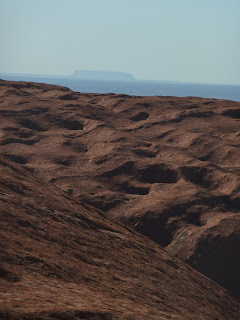
The views from the top are pretty grand, and it's interesting to see something our guide said about geology: a lot of the features around here are in a straight line because their constituents were originally carried by water. Only from the top are you high enough to see Kata Tjuta in one direction, then turn 180 degrees to see Mount Conner, Australia's highest table mountain.* There are a couple more features in the same line, too far away to see.
* We drove past this on our way from Alice Springs. It's big and red and flat on top. A lot of people mistake it for Uluru, but at least they have a clue what Ayers Rock looks like, which is more than Lilly did!
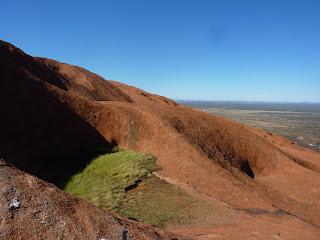
The other great thing about coming up here is getting a completely different perspective. The Aboriginals tell us to really see the rock, rather than taking lots of photos. I don't think you can see it properly until you're on it, seeing pools of water and patches of plant life and undulations like a giant beach that you can't see from the base. And putting both hands on the rock to help yourself up or down slopes means you really feel and appreciate the rock in a way that you wouldn't if your life didn't depend on it. Should we have climbed it? Not sure. Am I glad we did? Definitely.
Our tour is a bit disrupted by the rain a few days ago - we're supposed to drive to a campsite in Kings Canyon in the afternoon, but it was badly damaged and access was blocked for a few days - the Canyon itself was closed until the day before we walk it and poor tour groups have spent their third day doing activities in Alice Springs which - as I'll get to in a later post - would be a massive let-down on the quality scale. Luckily we're still going, but we're staying at the same camp here for a second night and doing a massive drive there in the early morning, so we have a spare afternoon to kill. We get dropped in the resort town near Uluru and sneak into one of the hotels for an unlicensed swim in their pool (encouraged by our guide - the hotels don't seem to notice or mind). We take in sunset from the lookout by our camp - which means my sprint the previous evening was a bit of a waste! It's the equinox tonight and a couple of people are playing Rolf Harris style traditional music, which adds a little atmosphere.
We take up the offer of leaving our canvas cabins and sleeping in swags - thick canvas sleeping bags with mattresses - under the stars. This is pleasantly cool compared to the cabins when we go to sleep, but a bit chillier when we wake up. Still, nothing ate us, so I count that as a win. Even after the previous night, the number of stars in the sky comes as a surprise. I don't think I could process it properly so I just had it filed as 'lots'. It's more than that.
Unfortunately our new schedule means we're up at 3am for the 3.5 hour drive, so we can walk Kings Canyon before it gets too hot (forecast is 35 degrees in the shade today).
Just for a minute, as we drive along straight roads surrounded by largely flat country, with low red cliffs rising to our right and the full set of colours of dawn all around us, I can understand why people live here. And then I think, hold on, what are you doing awake at 6:30am, and do you remember how hot it's going to be in a couple of hours and how many insects are going to annoy you today? Oh yeah. I still can't understand why people live here.
But Kings Canyon is worth it. A fantastic walk. The canyon itself is very scenic - red rocks with a scattering of plant life - but it's the top of the canyon that is stunning. The rocks around here have all had water seep into tiny cracks and expand, leaving them looking like ancient buildings constructed from thin red bricks (like most stone around here, it is naturally white but the exposed surface oxidises to various shades of red). I've never seen anything quite like it and did not get tired of it.
By the second half of the walk you can see that in many places the rock has formed domes of ersatz mortarless brick.
Plants cling to life wherever they can - including some that are found virtually nowhere else, but persist here because a layer of shale in the rock strata means that water gets trapped here above the water table. Part of the walk is known as the Garden of Eden for that reason.
Halfway round is a side path to a secluded pool with steep cliffs on all sides - newly topped up with rainwater, and warmer than you would expect (perhaps because water flows into it over and through hot rocks), it's a great place for a cooling swim.
Kings Canyon is just a spectacular place, and a beautiful morning's walk. Definitely my favourite thing to do in this part of the world.
And that's pretty much it for the tour, or will be after the 4.5 hour drive back to Alice Springs. Two more good moments - one when our tour bus does an unexpected U-turn because the driver has spotted a Thorny Devil asleep in the road. This is a very strange-looking spiny lizard, about 6 inches long, whose defence posture is to hide its head under its front paws which makes a little fake head pop up from the back of its neck. Cute. We leave him back safely on the side of the road.
The second is at lunchtime, when a French woman asks me "What is this meat? It is a strange colour." "That's beef," I explain, "but properly cooked."
The land in general is greener than I expected - this is semi-arid desert, so there are still trees and bushes and grass, though the soil is red. There's not a lot of water, even though there has been an unusual amount of rain recently - the rivers are puddles, but not dry. And it's pretty hot - 32° in the shade, 34°-37° in the sun today. We're coming towards the end of the off season here. Peak season is April-September.
The three main things we're here to see are Uluru (better known as Ayers Rock), Kata Tjuta (aka the Olgas), and Kings Canyon. We're on a tour with (at various stages) 6-10 other people - all female. Normally where you have a decent tourist attraction, tour operators will look for a few other things 10-20 miles away that they can throw in to make up a bigger tour. Here, they throw in pretty much everything within a few hundred kilometres, because those three are pretty much all there is to see for hundreds of kilometres in each direction. But they are very fine sights - and I get plenty of time to catch up with my reading on the bus.
It's a bit of a drive from Alice Springs to Uluru: "462km, 2 right turns, no left turns" as our driver puts it. Along the way there are a couple of rest stops. First up is the camel farm. You can ride a camel once round the yard for 6 bucks - the same price as a camel burger.
Also available in a bun
They also have emus, kangaroos and a dingo. Further down the road, at the last beer shop before the rock, there's a fine display of colourful parrots, a cockatoo that startles Lilly by saying "Hello" (I know, I was expecting it to say "G'day", too), more emus wandering around and more kangaroos. They have a "Help wanted" sign up here, if anyone fancies a job with a bit of a commute. It's also fun to see supply and demand in operation as the prices of everything rises along the road.
And a big cactus. Don't forget the cactus.
Kata Tjuta is our first activity. It's only about 30km from Uluru as the crow flies, but completely overshadowed (metaphorically - Uluru isn't that tall), which is a shame because it's a stunning place.
First view of Kata Tjuta
From above ground it appears to consist of 36 huge rounded rocks which rise as high as several hundred metres above ground and descend up to 5km into the earth below. Some of the rocks run together, making it a mass of red stone hills and valleys. It looks a bit like Uluru might if it were selectively eroded - the rock is different but looks very similar from any real distance. Its Aboriginal name means "many heads".
We go on the Valley of the Winds walk, which leads up and down and through, with some great views and occasional glimpses of rock wallabies in the distance. We don't get to do the whole circuit because 4 days earlier a huge amount of water fell, leading to big black marks where water ran down the rocks and several washed-out paths. But we see enough to be very impressed.
We drive to a lookout near Uluru for sunset - not that spectacular since the spot is both very busy and in between Uluru and the setting sun. There's a great little lookout point by our campsite where you can see Kata Tjuta against the sunset, and I sprint up there when we get back for a just-in-time photo.
Of course the great night-time view is upwards. With no moon, virtually no lights and no clouds, the night sky is unbelievable. I have never seen so many stars, not even close, even in the countryside, or in the Canadian Rockies. Just breath-taking.
What's 8 inches long, makes women scream and can be found outside the camp toilets?
Also breath-taking was how early we have to get up to be at Uluru for sunrise. It's a bit better than sunset, and the great advantage is that you can walk the 'base walk' loop around the rock without the crowds or heat that come a little later. At times, Lilly and I are the only people around - which means there are approximately 1,000 flies for each of us. Every time I stop walking to take a photo they swarm and I invariably end up with one in my ear while snapping away. This is a pretty good walk - long but not unbearably so (though the shade is very welcome as early as 7:30 a.m.), starting some way from the rock to give you perspective but getting closer until you can touch it, or play frisbee by it, for the second half of the walk.
One of the reasons to see Uluru at sunrise and sunset is that it famously changes colour. For my money this is very overplayed. Hardly a surprise that it looks different in the dark from indirect sunlight from direct sunlight!
We were feeling a bit leggy after walking all around Uluru
And skipping ahead to a near sunset view
Climbing Uluru is a bit controversial. It is permitted, but the Aboriginal people prefer you not to - so there is a sign saying "Please don't climb", but the entrance gate is only closed in adverse weather (which includes being too hot). The info centre says that the proportion of visitors who climb has fallen from c75% to 37%, and cryptically adds that some nationalities are more likely to climb than others. (We noticed that some nationalities are also more likely to give the peace sign or try to take a photo in mid-jump on the Rock. But this is presumably a tour operator thing - if your bus stops and the guide says "Today we are climbing that great big rock", you generally climb the rock.) The main reason given for not climbing is that the Aboriginals feel responsibility for visitors and are sad if they are hurt or die while climbing. There's clearly more to it than this (I believe that Aborigonals only climb as a rite of passage), but neither the rock nor the cultural information centre makes any attempt to explain it. In fact the centre as a whole tells you very little about Aboriginal culture apart from what they eat, and in general they disclose very little of what they do at Uluru and nothing of what they do/did at Kata Tjuta. They are perfectly entitled to their privacy; but if they want people to respect their beliefs, they might gain more traction if they explain them.
That was easy. What's the big deal?
We hadn't planned to climb, and I wouldn't have done if it looked like nobody else was. But there were three coachloads of Japanese tourists up there at the time, so the amount of extra offence we were likely to cause seemed minimal, and when we were told that the two Japanese girls in our group had gone for a climb and were asked (not encouraged) if anyone else wanted to, we decided to go for it.
What, no lift?
This was about 9:30 and it was already a very hot day. The first half of the climb is a fairly steep slope with a chain to help you if you need it. That covers about 75% of the height gain; the rest is up and down, only occasionally steep, and covers a lot of ground laterally. It's fairly intimidating. But every time we wonder if we're mad for trying, we see an elderly Japanese tourist or 5-year-old child coming down, and you really feel you have no excuse for stopping.
The views from the top are pretty grand, and it's interesting to see something our guide said about geology: a lot of the features around here are in a straight line because their constituents were originally carried by water. Only from the top are you high enough to see Kata Tjuta in one direction, then turn 180 degrees to see Mount Conner, Australia's highest table mountain.* There are a couple more features in the same line, too far away to see.
* We drove past this on our way from Alice Springs. It's big and red and flat on top. A lot of people mistake it for Uluru, but at least they have a clue what Ayers Rock looks like, which is more than Lilly did!
The other great thing about coming up here is getting a completely different perspective. The Aboriginals tell us to really see the rock, rather than taking lots of photos. I don't think you can see it properly until you're on it, seeing pools of water and patches of plant life and undulations like a giant beach that you can't see from the base. And putting both hands on the rock to help yourself up or down slopes means you really feel and appreciate the rock in a way that you wouldn't if your life didn't depend on it. Should we have climbed it? Not sure. Am I glad we did? Definitely.
Our tour is a bit disrupted by the rain a few days ago - we're supposed to drive to a campsite in Kings Canyon in the afternoon, but it was badly damaged and access was blocked for a few days - the Canyon itself was closed until the day before we walk it and poor tour groups have spent their third day doing activities in Alice Springs which - as I'll get to in a later post - would be a massive let-down on the quality scale. Luckily we're still going, but we're staying at the same camp here for a second night and doing a massive drive there in the early morning, so we have a spare afternoon to kill. We get dropped in the resort town near Uluru and sneak into one of the hotels for an unlicensed swim in their pool (encouraged by our guide - the hotels don't seem to notice or mind). We take in sunset from the lookout by our camp - which means my sprint the previous evening was a bit of a waste! It's the equinox tonight and a couple of people are playing Rolf Harris style traditional music, which adds a little atmosphere.
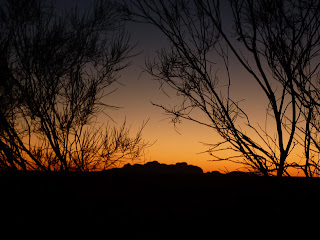
We take up the offer of leaving our canvas cabins and sleeping in swags - thick canvas sleeping bags with mattresses - under the stars. This is pleasantly cool compared to the cabins when we go to sleep, but a bit chillier when we wake up. Still, nothing ate us, so I count that as a win. Even after the previous night, the number of stars in the sky comes as a surprise. I don't think I could process it properly so I just had it filed as 'lots'. It's more than that.
Unfortunately our new schedule means we're up at 3am for the 3.5 hour drive, so we can walk Kings Canyon before it gets too hot (forecast is 35 degrees in the shade today).
Just for a minute, as we drive along straight roads surrounded by largely flat country, with low red cliffs rising to our right and the full set of colours of dawn all around us, I can understand why people live here. And then I think, hold on, what are you doing awake at 6:30am, and do you remember how hot it's going to be in a couple of hours and how many insects are going to annoy you today? Oh yeah. I still can't understand why people live here.
But Kings Canyon is worth it. A fantastic walk. The canyon itself is very scenic - red rocks with a scattering of plant life - but it's the top of the canyon that is stunning. The rocks around here have all had water seep into tiny cracks and expand, leaving them looking like ancient buildings constructed from thin red bricks (like most stone around here, it is naturally white but the exposed surface oxidises to various shades of red). I've never seen anything quite like it and did not get tired of it.
By the second half of the walk you can see that in many places the rock has formed domes of ersatz mortarless brick.
Plants cling to life wherever they can - including some that are found virtually nowhere else, but persist here because a layer of shale in the rock strata means that water gets trapped here above the water table. Part of the walk is known as the Garden of Eden for that reason.
All this used to be under water..
Halfway round is a side path to a secluded pool with steep cliffs on all sides - newly topped up with rainwater, and warmer than you would expect (perhaps because water flows into it over and through hot rocks), it's a great place for a cooling swim.
Kings Canyon is just a spectacular place, and a beautiful morning's walk. Definitely my favourite thing to do in this part of the world.
Click on photo for bigger version
And that's pretty much it for the tour, or will be after the 4.5 hour drive back to Alice Springs. Two more good moments - one when our tour bus does an unexpected U-turn because the driver has spotted a Thorny Devil asleep in the road. This is a very strange-looking spiny lizard, about 6 inches long, whose defence posture is to hide its head under its front paws which makes a little fake head pop up from the back of its neck. Cute. We leave him back safely on the side of the road.
The second is at lunchtime, when a French woman asks me "What is this meat? It is a strange colour." "That's beef," I explain, "but properly cooked."
Labels:
Alice Springs,
Australia,
Kings Canyon,
Red Centre,
Uluru
Subscribe to:
Posts (Atom)